EndoAxis Clinical Team

Hormone testing has evolved beyond the static assessment of single hormone levels, ushering in a new era of dynamic, multi-layered metabolic evaluation. At EndoAxis, we built a technology-driven diagnostic platform designed to bridge the complexity of hormone synthesis, conversion, and clearance, with an emphasis on metabolite mapping and enzymatic behavior.
But how do we come up with the patterns?
Sex Hormones: It’s All About Relationships
EndoAxis evaluates testosterone, DHEA, progesterone, and estrogen not in isolation, but through how they relate to each other and to their downstream metabolites. The equations integrate probable enzyme expression across tissues such as the ovary, adrenal gland, liver, and peripheral fat to contextualize metabolism in hormonally active environments. These relationships are modeled using:
- Enzyme-driven synthesis maps (CYP19, HSD17B, 5α-reductase, etc.)
- Estimated enzyme activity based on known genetics and tissue-specific expression
- Metabolite ratios that reveal real-time dynamics of hormone production, detoxification, and clearance
The result? A pattern-based readout that can identify, for example, estrogen dominance with impaired hydroxylation, or androgen excess with skewed 5α-reduction—before overt labs show an abnormality.
Adrenal Patterns: A Deeper Look at Cortisol
For adrenal hormones, EndoAxis focuses on the balance between free cortisol and
metabolized clearance—especially the ratio of THE to THF, which reflect 11bHSD, 5α- reductase activity and HPA axis dynamics.
With this, providers can distinguish between:
- Low free cortisol with fast metabolizer phenotype
- Active HPA-axis activity signaling stronger pulsations of cortisol throughout the day, with sluggish metabolism of cortisol
- Metabolic stress signatures with skewed cortisol:cortisone ratios
You don’t just get a number—you get a narrative.
From Overview to Precision
EndoAxis first gives you a high-level view of the major cellular imbalances driving symptoms (e.g., inflammatory metabolite dominance, impaired methylation, excess clearance). Then it dives deeper: layering in patient-specific variables like age, symptoms, and targeted metabolite relationships to support precision care.
It’s a shift from “test-and-treat” to pattern recognition and intervention.
How You Can Use EndoAxis®
Whether you’re managing
- Unexplained fatigue, PMS, perimenopause
- HPA dysfunction with “normal” cortisol
- Complex cases of hormone therapy response
- At-risk patients with estrogen-sensitive conditions
EndoAxis adds a crucial layer of biochemical clarity. EndoAxis helps bridge the gap between traditional hormone interpretation and systems-level endocrinology.
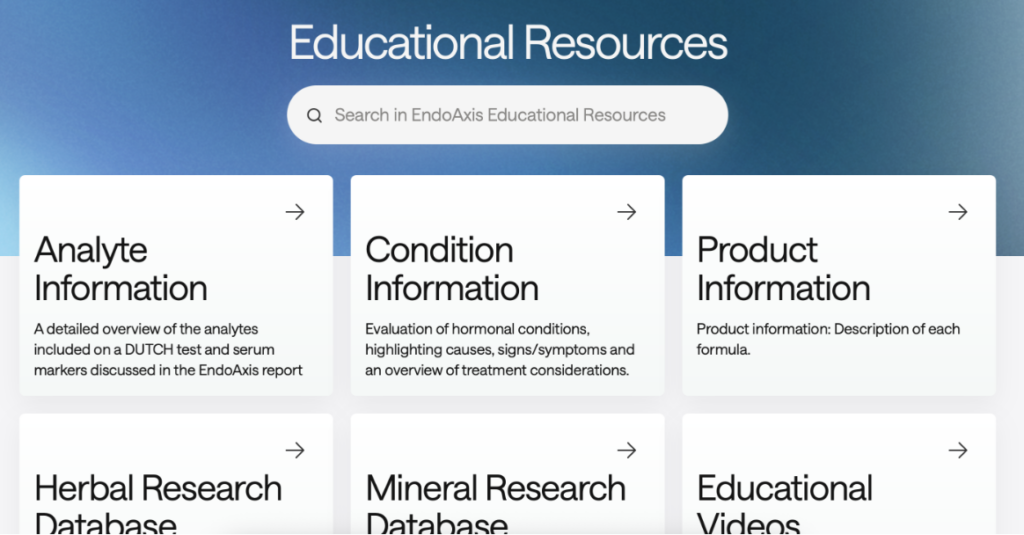
We also offer providers access to our comprehensive Education Center – a dedicated resource designed to deepen your understanding of key analytes reviewed on the DUTCH report, hormone-related conditions database, and the clinical research supporting every ingredient used in our product formulations.
Whether you’re looking to enhance diagnostic accuracy or explore the science behind targeted interventions, the Education Center is built to support your clinical decision-making and empower more informed patient care.