EndoAxis Clinical Team
Urine Testing and Metabolites — Why They Matter
Most estrogen discussions stop at total estradiol, estrone, and estriol — but the real clinical goldmine is in how those estrogens are metabolized.
Urine testing provides a map of estrogen’s downstream metabolites, showing not only hormone production but also detoxification efficiency.
For estrogen, that means three primary hydroxylation pathways:
- 2-OH → “Protective” pathway, producing weak estrogens with anti-proliferative tendencies.
- 4-OH → Potentially DNA-damaging catechols if not methylated efficiently.
- 16-OH → Estrogenic (binds to ER receptors – similar to E1 and E2), promotes cell proliferation, and is also the direct precursor to estriol.
By seeing the proportion of each pathway, we can evaluate not just hormone quantity, but metabolic safety and balance.
The 16-OH Pathway – Pros and Cons
Pros
- Produces estriol, the third major estrogen, which is generally considered gentler than estradiol and estrone.
- Plays a role in vaginal, urinary, and mucosal tissue integrity — especially relevant in postmenopausal women and during pregnancy.
- Supports certain aspects of bone health and collagen synthesis.
Cons
- 16-OH metabolites are highly estrogenic — they bind strongly to estrogen receptors and stimulate proliferation, especially in breast and endometrial tissue.
- If unopposed, excessive 16-OH activity has been linked to increased estrogen-driven cancer risk.
- Elevated 16-OH can worsen symptoms in estrogen dominance (breast tenderness, heavy bleeding, fibroids).
How Estriol Interacts with 16-OH
Estriol is synthesized directly from the 16-OH pathway.
Here’s the key point: while 16-OH-estrone is highly proliferative, estriol itself is only weakly estrogenic in most tissues. It often acts as a partial agonist, meaning it can compete with stronger estrogens for receptor binding and blunt their full stimulatory effect.
In other words:
Healthy 16-OH → estriol conversion = softer, more protective estrogen signaling.
Excess 16-OH without adequate conversion to estriol = potential for unchecked proliferation.
Why Estriol Deserves More Attention
In conventional hormone replacement therapy, estriol is often ignored or minimized, yet it:
- Promotes mucosal and skin health without the same clotting or breast stimulation risks as estradiol.
- May have anti-proliferative effects in breast tissue when competing with estradiol.
- Plays a role in immune modulation, reducing inflammatory and autoimmune triggers in some patients.
- Has been associated with lower recurrence rates of certain estrogen-sensitive cancers in observational studies when part of a balanced estrogen mix.
Think of estriol as the soft landing for estradiol. Estriol helps balance the intensity and efficacy of estradiol while simultaneously allowing estradiol to shine.
Clinical Pearl
When reviewing urinary hormone test results, don’t just look at total estrogen levels.
If 16-OH is high and estriol is low, look at the conversion step — 16-OH E1 reduces to form estriol, catalyzed by 17b-hydroxysteroid dehydrogenases (17b-HSDs). These enzymes are most active in the ovary, endometrium and placenta, but also express in the liver.
- Higher conversion of 16-OH E1 into Estriol can be driven by estrogen OR progesterone dominance, insulin, IGF-1 and pregnancy.
- Lower conversion of 16-OH E1 into Estriol can be a result of androgen excess, or high TGF-b, which is like a universal repair signal that elevates because of many pro-inflammatory cytokines, including TNF-a and IL-6.
Supporting optimal hormone balance can come through targeted supplementation, liver phase II support, immune support, blood sugar balance and addressing genetic polymorphisms (e.g., CYP3A4, COMT).
It is important to remember that these enzymes do not work solely in the liver, and any manipulation of detox-focused enzymes may influence detoxification, both good and bad! Instead – DO NOT SUPPRESS. Instead focus on the factors that drive up or down the expression of the enzymes.
If estriol is robust despite higher 16-OH, you may be looking at a more balanced proliferative-to-protective estrogen environment.
Below is a great example of how higher estriol and 16-OH look on urine testing (DUTCH test).
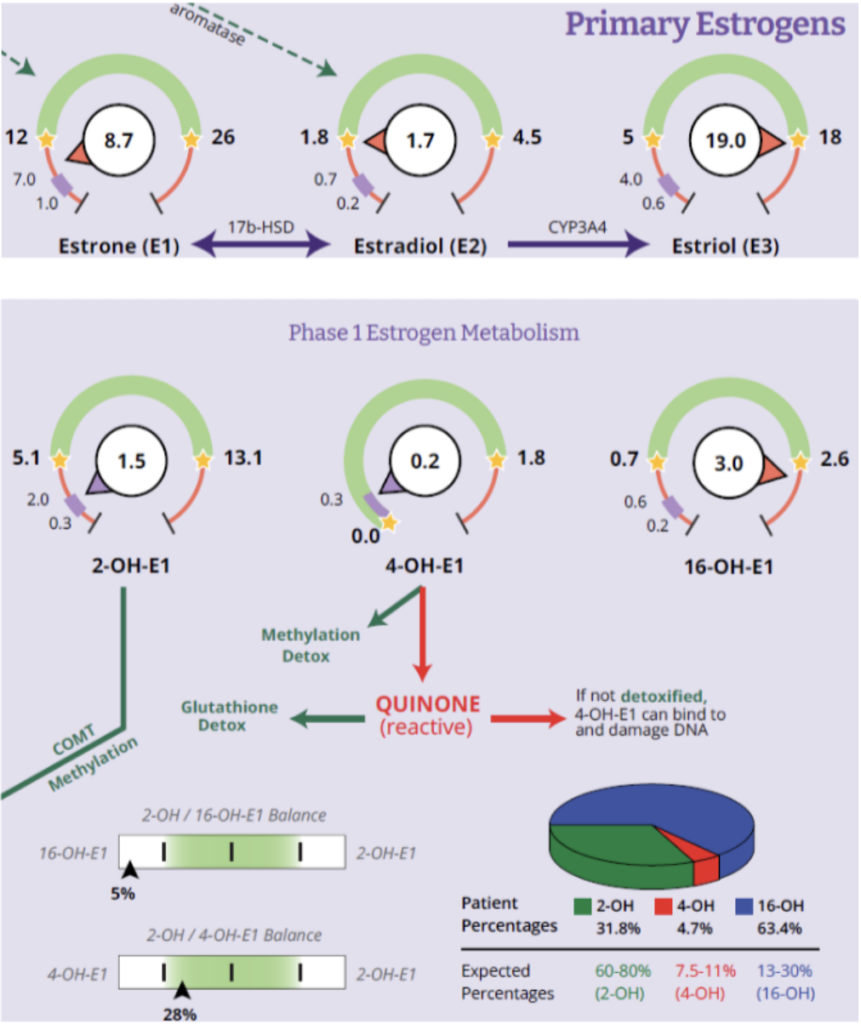
EndoAxis technology enhances understanding of how to interpret these levels.
Remembering that the human body is dynamic, and not all levels are static, the EndoAxis report helps pull together all the enzyme function and patterns for considerations needed to ensure optimal support and evaluation.
As the provider, you still know your patient best – we merely offer supplemental insight for best therapy options.