EndoAxis Clinical Team
This week’s Insights & Innovations focuses on estrogen receptor (ER) differentiation and function. As you know, ERα, ERβ, and GPER each play distinct roles in genomic and non-genomic signaling. Estradiol and estriol interact with these receptors in nuanced ways—offering opportunities for targeted therapeutic interventions.
3 Main Types of Estrogen Receptors (ERs)
There are three main types of estrogen receptors (ERs), each with distinct structures, functions, and tissue distributions:
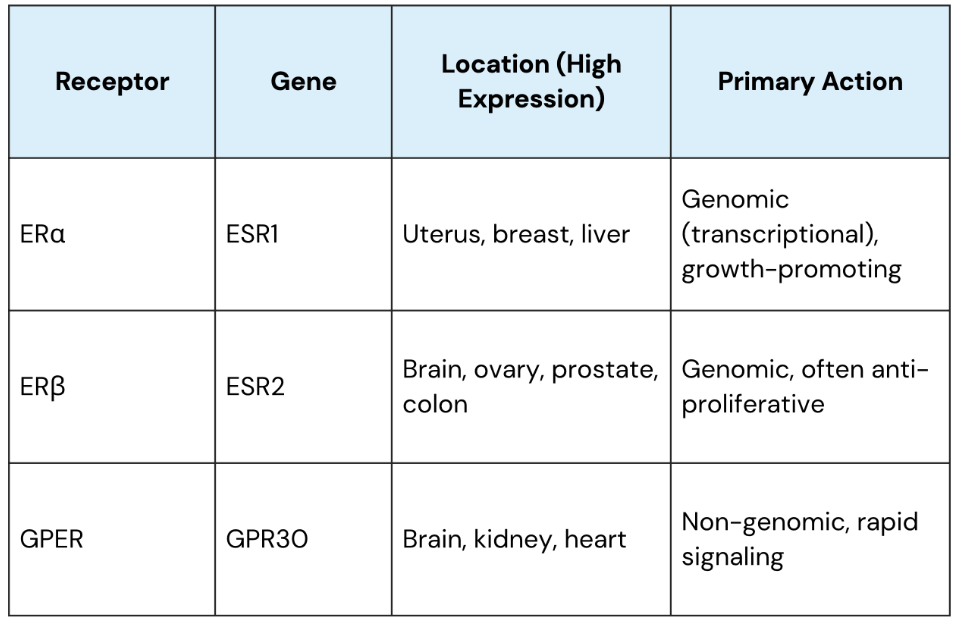
| Estrogen Receptor Alpha (ERα) | Gene: ESR1 Location: Predominantly found in reproductive tissues like the uterus, breast, ovaries, as well as in the liver, adipose tissue, and hypothalamus. Functions: Regulates reproductive and sexual development Influences fat distribution and metabolism Critical in breast cancer progression (ER+ breast cancers) |
| Estrogen Receptor Beta (ERβ) | Gene: ESR2 Location: More abundant in ovaries, prostate, lungs, gastrointestinal tract, cardiovascular system, bladder, and brain. Functions: Often counterbalances ERα (e.g., anti-proliferative effects) Has roles in mood regulation, neuroprotection, and inflammation Thought to be protective in certain cancers |
| G Protein-Coupled Estrogen Receptor (GPER/GPR30) | Type: Membrane-bound, non-classical receptor Location: Found in cell membranes of multiple tissues including kidneys, cardiovascular system, and brain Functions: Mediates rapid, non-genomic signaling (e.g., calcium mobilization, kinase activation) Plays a role in vascular tone, metabolism, immune modulation, and possibly insulin sensitivity |
Summary Comparison Table
How Estradiol Influences Estrogen Receptors
Estradiol (E2): The most potent, bioactive estrogen
Highest affinity for ERα and ERβ.
Balanced action:
- Strongly activates ERα (growth-promoting, mitogenic).
- Also activates ERβ, which can temper ERα effects depending on tissue.
- Also activates GPER, triggering non-genomic pathways (e.g., vasodilation, neuroprotection).
Effects depend on:
- Receptor subtype expression in tissue:
- E.g., breast tissue is rich in ERα → estradiol can promote growth and cell division.
- Brain tissue has more ERβ → estradiol promotes neuroprotection and mood stability.
How Estriol Influences Estrogen Receptors
Estriol (E3): A weaker, less potent estrogen
Much lower affinity for ERα and ERβ.
It acts as:
- Partial agonist/antagonist depending on tissue and presence of stronger estrogens like estradiol.
- Prefers ERβ > ERα, though weakly.
- Can occupy the receptor and blunt more aggressive estrogen signaling (esp. ERα).
Clinical insight: Estriol is sometimes described as a “gentle” estrogen—it provides mild estrogenic effects without strongly stimulating growth.
This is why it’s explored in:
- Vaginal atrophy
- Menopausal therapy can also temper endometrial hyperplasia in use with estradiol (2)
- Some research suggests estriol may be protective in certain cancers