EndoAxis Clinical Team
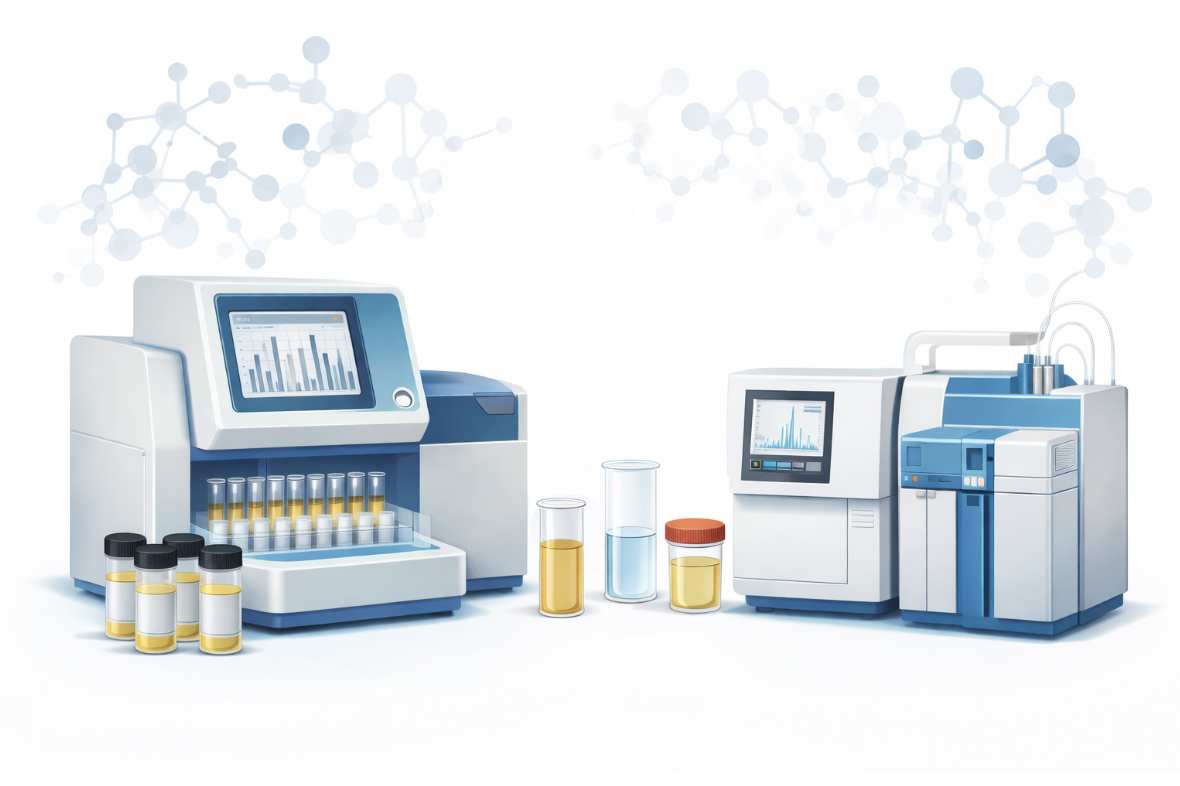
Just as important as the type of testing is the way hormones are tested!
Let’s dive into the different methodologies:
Immunoassay vs LC/MS vs GC/MS: Why the Method Matters in Hormone Testing
When clinicians compare serum, saliva, and dried urine testing, the testing methodology behind those results often gets overlooked. But the assay type dramatically affects accuracy, sensitivity, cross-reactivity, and clinical interpretation — especially for sex steroids in women, where concentrations are low and metabolites share structural similarity.
The two main analytic platforms you’ll encounter, are:
- Immunoassay (IA)
- Liquid Chromatography–Mass Spectrometry (LC/MS or LC-MS/MS)
With an additional discussion on:
- Gas Chromatography-Mass Spectrometry (GC/MC or GC-MS/MS)
- Equilibrium dialysis (ED)
These lab methods are not interchangeable, and knowing their differences is foundational for confident hormone interpretation.
Immunoassay (IA)
(ELISA, CLIA, RIA, ECLIA, etc.)
How it works
Immunoassays rely on antibodies that bind to the target hormone. A detectable signal (light, radioactivity, fluorescence) is produced in proportion to the amount of hormone bound.
Strengths
- Fast, inexpensive, high throughput.
- Widely used in standard hospital labs.
- Well-validated for high-concentration hormones:
- LH, FSH
- Prolactin
- TSH
- DHEA sulfate
Where it breaks down
Cross-reactivity.
Antibodies don’t always distinguish between structurally similar molecules. This becomes a problem when measuring:
- Estradiol in postmenopausal ranges
- Total testosterone in women
- Progesterone metabolites
- Androgen metabolites
- DHEA vs DHEA-S
Even 1–5% cross-reactivity can artificially elevate values when the intended hormone is low and structurally similar molecules are more abundant.
Lack of sensitivity at low levels.
Women’s sex steroid concentrations are often near the lower limit of detection,
causing:
- “Normal” results that miss truly low estradiol
- Erratic follicular-phase estrogen readings
- Overestimated testosterone
- Bad data for clinical decision-making
Matrix interference.
Biotin (for more information on Biotin interference, see our discussion here, heterophile antibodies, lipemia, and other factors can distort results.
Clinical takeaway
Immunoassay is a sensitive but not specific lab test, meaning that it can help identify if true negative, but not a true positive. are adequate for diagnosis of most endocrine disorders but can produce misleading sex-steroid values, particularly in cycling or postmenopausal women.
Liquid Chromatography–Mass Spectrometry (LC/MS, LC-MS/MS)
How it works
LC/MS physically separates molecules by chromatography, then identifies and quantifies them based on mass-to-charge ratio. It does not rely on antibodies.
Strengths
Extremely high specificity & sensitivity.
- LC/MS distinguishes molecules with nearly identical structures — estradiol vs estrone vs estriol, testosterone vs DHT, etc.
- Excellent for low concentration hormones.
- Estradiol in follicular or postmenopausal ranges
- Testosterone in women
- Pregnenolone, progesterone metabolites
- Androgen metabolites (5α vs 5β)
Able to quantify many compounds simultaneously.
Multiplex panels are possible (e.g., 15–30 metabolites in a single run). Not susceptible to antibody cross-reactivity.
Limitations
More expensive, may not be available in every lab, requires specialized equipment and personnel, turnaround time can be longer, insurance coverage is inconsistent
Clinical takeaway
LC/MS is the gold standard in serum for measuring sex steroids accurately, especially in females or in any situation requiring precise quantification at low ranges.
Why this matters clinically
A follicular-phase estradiol of 32 pg/mL by immunoassay may actually be 12 pg/mL by LC/MS — the difference between “normal cycling estrogen” and “early ovarian insufficiency physiology.”
A total testosterone of 32 ng/dL by immunoassay may be 14 ng/dL by LC/MS — the difference between “normal” and “truly low.”
In other words, the method determines the truthfulness of your data, and for women’s hormones, LC/MS often prevents misclassification.
Gas Chromatography–Mass Spectrometry (GC-MS)
GC-MS is a high-specificity, high-resolution analytical technique similar in purpose to LC-MS/MS, but with a different separation method. It is excellent for volatile or derivatized compounds and is still considered the historical gold standard for steroid metabolite analysis.
How GC-MS Works
- Sample → vaporized
- Compounds separate in a gas chromatography column
- Then identified by mass spectrometry
- Often requires derivatization, meaning chemical modification to make the
- molecule more volatile
Result:
GC-MS produces extremely clean, highly specific chromatograms, but is more labor-intensive and slower than LC-MS/MS.
Strengths of GC-MS
- Exceptional specificity
- Especially for steroid metabolites. Before LC-MS/MS matured, GC-MSwas the reference method for:
- Estrogen metabolites
- Cortisol metabolites
- Androgen metabolites
- Especially for steroid metabolites. Before LC-MS/MS matured, GC-MSwas the reference method for:
- Very low matrix interference
- Because the extraction + derivatization steps remove a lot of background biological noise.
- Strong historical dataset
- Many classic endocrinology studies from the 1980s–2000s used GC-MS as the reference.
Limitations of GC-MS
- Requires derivatization
- This adds complexity, increases turnaround time, and introduces a potential source of analytic variability.
- Not ideal for fragile compounds
- Certain hormones degrade with heat during vaporization.
- Less efficient for routine clinical testing
- It is slower, more labor-intensive, and not as automation-friendly as LC-MS/MS.
- Not widely available in commercial clinical labs
Most modern clinical labs now rely on LC-MS/MS for steroids because of speed and ease.
Equilibrium dialysis
Equilibrium dialysis (ED) is a laboratory technique used to measure the free (unbound) fraction of a molecule in a biological sample, most commonly hormones such as testosterone, cortisol, or thyroxine. Unlike total hormone measurements, ED isolates the fraction that is biologically active and able to interact with receptors.
How it works:
- A biological sample (serum, plasma) is placed on one side of a semipermeable membrane.
- The membrane allows small molecules (free hormones) to pass through butretains larger molecules such as binding proteins (e.g., SHBG, albumin, CBG).
- A protein-free buffer solution is placed on the other side of the membrane.
- Free hormones diffuse across the membrane until equilibrium is reached—concentration of free hormone is equal on both sides.
- Once equilibrium is achieved, the dialysate is sampled.
- Hormone concentration is measured, usually via LC–MS/MS, GC–MS, or occasionally highly specific immunoassays.
- This measured concentration represents the free (unbound) hormone in the original sample.
Commonly used for: free testosterone, free cortisol, thyroxine
Advantages:
- Gold standard for free hormone measurement.
- Physically separates free vs bound hormone without chemical interference.
- Highly reproducible when performed correctly.
Limitations:
- Labor-intensive and time-consuming (hours for equilibrium).
- Requires careful temperature and pH control.
- Not high throughput; typically done in reference labs.
- Requires subsequent accurate measurement method (LC–MS/MS or validated IA).
As a provider, we carry the responsibility to know what to test, and to understand the best way to test hormones for evaluation. EndoAxis initially chose to work with the DUTCH test as they are validated testing, offering LC-MS and GC-MS for exceptional specificity in hormone evaluation. With accuracy in testing, we can support providers through superior technology evaluation and interpretation alongside high quality products that address metabolic and enzyme dysfunction getting to the root cause of hormone imbalance.