EndoAxis Clinical Team

Environmental Hormone Disruptors in Plain Sight
When summertime arrives, visions of sun-soaked vacations, backyard barbeques, and endless outdoor fun fill our minds. Yet woven into these pleasures are hidden risks: increased exposure to environmental toxins that can subtly disrupt our hormone balance. The interplay of sunlight, smoke from grilling, and even certain charred foods introduces an array of compounds that stress our metabolic pathways, especially those governing estrogen and cortisol. Being mindful of these exposures and taking steps to support our natural detoxification systems can help us enjoy summer’s abundance while safeguarding our long-term well-being.
UV Exposure: Estrogen Biotransformation and Methylation Strain
Mechanisms of Disruption:
CYP1B1 Induction: UV-induced oxidative stress upregulates CYP1B1, promoting conversion of estradiol (E2) to 4-hydroxyestradiol (4-OH-E2) — a redox-active metabolite with genotoxic and procarcinogenic potential.
COMT Demand and Methylation Burden: Detoxification of 4-OH-E2 via catechol-O-methyltransferase (COMT) requires methyl donors (SAMe, B12, folate). Chronic oxidative exposure depletes these cofactors, impairing safe estrogen metabolism.
DNA Damage and Estrogen Quinones: Unmethylated catechol estrogens can auto-oxidize to estrogen quinones, initiating DNA adduct formation and contributing to carcinogenesis (e.g., breast, skin).
Clinical Takeaway:
Excess UV exposure tilts estrogen metabolism toward 4-OH pathways and heightens DNA damage risk, especially in methylation-compromised patients.
Supportive Interventions:
- Botanical CYP1B1 modulators: EGCG (green tea), rosemary, and sulforaphane downregulate CYP1B1, favoring the safer 2-OH estrogen pathway.
- Methylation support: Folate, methyl-B12, SAMe, and magnesium enhance COMT efficiency and reduce catechol estrogen burden.
- DNA Protection: Astaxanthin and other carotenoids may help buffer UV-induced oxidative DNA damage and reduce 4-OH upregulation.
Smoke Exposure: PAHs, Estrogen Quinones, and Cortisol Dysregulation
Mechanisms of Disruption:
PAH-Induced Enzyme Induction: Polycyclic aromatic hydrocarbons (PAHs) from wildfire smoke, fireworks, or pollution upregulate CYP1A1 and CYP1B1, increasing production of 4-OH and estrogen quinone metabolites with oncogenic potential.
Estrogen-DNA Adduct Formation: Quinone intermediates react with DNA to form depurinating adducts — a key early step in estrogen-driven carcinogenesis (notably in hormone-sensitive tissues).
Cortisol Amplification: PAHs activate the HPA axis and simultaneously inhibit 11β-HSD2, the enzyme responsible for inactivating cortisol. This results in elevated intracellular cortisol, promoting central adiposity, insulin resistance, and HPA dysfunction.
Clinical Takeaway:
Environmental smoke exposure is both estrogen-disruptive and cortisol-elevating through direct enzymatic effects and redox imbalance — a high-risk combination in hormonally vulnerable patients.
Supportive Interventions:
- NRF2 activation: Sulforaphane enhances transcription of detoxification and antioxidant enzymes (e.g., GST, NQO1), improving clearance of PAHs and reactive metabolites.
- Phase II conjugation support: NAC and glutathione preserve enzyme function and facilitate glucuronidation, sulfation, and methylation of estrogens and glucocorticoids.
- Adaptogenic modulation: Rhodiola and phosphatidylserine help regulate cortisol response and improve resilience under environmental stressors.
Charred Meats & Grilled Foods: A Hidden Burden on Estrogen and Liver Detoxification
Mechanisms of Disruption:
Heterocyclic Amines (HCAs) & PAHs: Generated during high-temperature grilling, these compounds act as CYP1 inducers, driving estrogen metabolism toward 4-OH and 16-OH pathways — both associated with proliferative and pro-inflammatory effects.
Phase II Enzyme Saturation: HCAs/PAHs increase oxidative load and deplete cofactors required by COMT, UGT, SULT, and GST, impairing estrogen and cortisol clearance.
Liver Burden: The combined effect of reactive oxygen species, quinones, and backed-up detoxification pathways contributes to hepatocellular stress, compromising both hormone clearance and metabolic regulation.
Clinical Takeaway:
Frequent consumption of grilled/charred meats introduces exogenous toxins that impair estrogen clearance, increase genotoxic intermediates, and burden hepatic detox — particularly concerning in patients with sluggish phase II activity or high estrogenic load.
Supportive Interventions:
- Phase II support: Calcium-D-glucarate enhances glucuronidation, facilitating excretion of estrogens.
- Enzyme modulators: Curcumin and rosemary inhibit CYP1B1 expression and mitigate HCA/PAH-induced DNA damage.
- Estrogen metabolism optimization: DIM and I3C (from cruciferous vegetables) promote 2-OH estrogen production and improve hepatic detox pathways (though we always want to ensure phase II detox is open and able to handle the load of clearance from phase I).
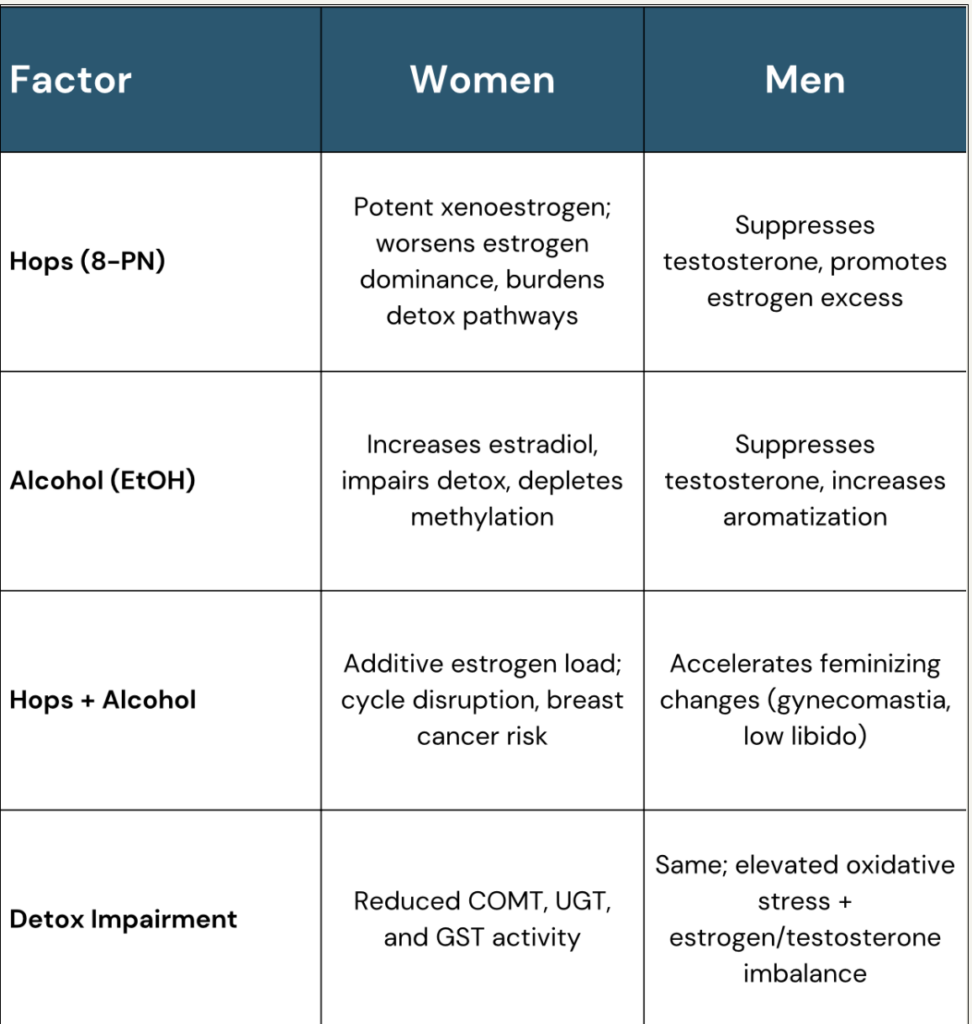
Cocktail & Happy Hour Summary: Hormonal Impact by Sex
Final Clinical Insight
Environmental exposures such as UV light, smoke, charred foods, and even happy hours aren’t just mild irritants, they are biochemical stressors. They influence estrogen metabolism, DNA stability, cortisol regulation, and methylation capacity. In individuals who are genetically predisposed or epigenetically burdened, these exposures can tip the scale toward hormone-driven disorders.
References:
1. https://www.epa.gov/wildfire-smoke-course/why-wildfire-smoke-health-concern
2. Fan Huang, Fan Gao, Chaoran Li, Luiza C. Campos. Photodegradation of free estrogens driven by UV light: Effects of operation mode and water matrix. Science of The Total Environment, Volume 835, 2022,155515, ISSN 0048-9697. https://doi.org/10.1016/j.scitotenv.2022.155515.
3. Liu C, Miyajima T, Melangath G, Miyai T, Vasanth S, Deshpande N, Kumar V, Ong Tone S, Gupta R, Zhu S, Vojnovic D, Chen Y, Rogan EG, Mondal B, Zahid M, Jurkunas UV. Ultraviolet A light induces DNA damage and estrogen-DNA adducts in Fuchs endothelial corneal dystrophy causing females to be more affected. Proc Natl Acad Sci U S A. 2020 Jan 7;117(1):573-583. doi: 10.1073/pnas.1912546116. Epub 2019 Dec 18. PMID: 31852820; PMCID: PMC6955350.