EndoAxis Clinical Team
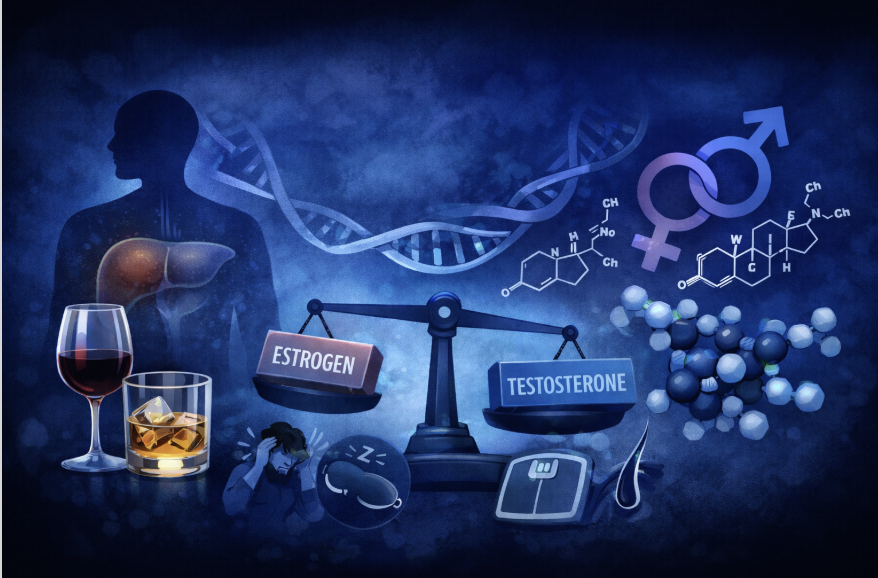
Alcohol is often framed as a lifestyle choice: a way to unwind, socialize, or take the edge off a long day. But biochemically, alcohol is not a neutral indulgence. It is a metabolic priority toxin that temporarily reshapes how the body produces, uses, and clears hormones.
Within minutes of ingestion, alcohol diverts liver function away from glucose regulation, fat metabolism, and hormone processing in order to be detoxified. During this window, the synthesis and clearance of key hormones, including cortisol, DHEA, estrogen, progesterone, and testosterone, are altered. These effects occur even at levels of intake commonly labeled “moderate.”
Alcohol and Hormone Synthesis: A Systems-Level View for Clinicians
Alcohol is commonly discussed in terms of liver health, cardiovascular risk, or caloric load. Far less attention is given to its role as a global endocrine modulator. Yet alcohol reliably alters hormone synthesis, metabolism, and signaling across the hypothalamic-pituitary-adrenal (HPA) and hypothalamic-pituitary-gonadal (HPG) axes- even at levels typically considered “moderate.”
What distinguishes alcohol from other lifestyle exposures is its ability to simultaneously activate the stress response while impairing hormonal balance and recovery. This dual effect helps explain why patients may report worsening sleep, anxiety, weight gain, cycle irregularities, or reduced stress tolerance despite otherwise “normal” laboratory values.
Alcohol as a Metabolic Priority care
From a biochemical perspective, alcohol is treated as a toxin. Once ingested, ethanol metabolism becomes a hepatic priority, temporarily diverting liver resources away from glucose regulation, lipid metabolism, and hormone processing.
Ethanol metabolism increases the hepatic NADH:NAD⁺ ratio, which has two clinically relevant consequences:
- Hormone clearance is reduced, allowing circulating steroid levels to riseindependent of production.
- Steroidogenesis becomes less efficient, as redox imbalance and oxidative stress impair enzyme activity.
Remember that steroid hormones require:
- Mitochondrial function – starting with the activation of STaR (steroid acuteregulatory protein).
- Cholesterol (fat) to build the hormones.
STaR is transiently “knocked out” when alcohol is consumed (meaning it will be temporarily turned off and unable to make sex hormones). The higher the alcohol intake, or the more habitual the intake becomes, the less STaR will be able to function over time, leading to less primary hormone synthesis.
Steroid hormones require NADH for the “activator” or currency to allow for cholesterol-to-pregnenolone conversion (and all subsequent downstream hormone transitions). If NADH is being sequestered to the liver for alcohol metabolism, less currency is available to support hormone synthesis.
This mean that less primary sex hormone synthesis will occur, while the less desired metabolites of these hormones can elevate. Alcohol can increase CYP3A4 and CYP1B1 expression, while reducing CYP1A1 expression. This means that 4-OH and 16-OH estrogens elevate, at the expense of the optimal (and most stable) 2-OH estrogen formation.
Alcohol can increase testosterone conversion into DHT (the most potent intermediate of testosterone). At the same time, alcohol is depleting zinc and many B-vitamins, including biotin, which are crucial for hair growth. This can lead to more severe cases of androgenic-pattern alopecia, despite declining total testosterone levels.
The result is not simply “more” or “less” hormone, but distorted hormone dynamics:
altered ratios, impaired feedback, and reduced signaling fidelity.
Let’s break this down further:
Effects on the HPA Axis: Cortisol and DHEA
Cortisol
Alcohol reliably activates the HPA axis. Acute intake increases corticotropin-releasing hormone (CRH) and adrenocorticotropic hormone (ACTH), leading to elevated cortisol levels. This response occurs even in individuals without chronic stress or alcohol dependence.
With repeated exposure, this adaptive response becomes maladaptive. Baseline cortisol levels may drift upward, feedback inhibition weakens, and diurnal rhythm becomes flattened or delayed. Clinically, this often presents as:
- Elevated evening or nighttime cortisol
- Reduced cortisol awakening response
- Increased sympathetic tone despite perceived relaxation
This pattern reflects increased allostatic load, with downstream effects on immune regulation, sleep architecture, insulin sensitivity, and central stress processing.
DHEA
At the adrenal level, alcohol shifts steroid output away from DHEA and toward cortisol. This occurs through increased ACTH demand, oxidative stress within the adrenal cortex, and impaired sulfation of DHEA to DHEA-S.
The resulting increase in the cortisol:DHEA ratio is clinically meaningful. This ratio has been associated with reduced stress resilience, accelerated biological aging, immune dysfunction, and mood disorders – even when absolute hormone values remain within reference ranges.
Effects on the HPG Axis and Sex Hormones
Alcohol disrupts sex hormone balance through a combination of central suppression, peripheral conversion, and altered clearance.
Estrogen
Alcohol increases circulating estrogen levels by:
- Reducing hepatic clearance
- Increasing aromatase activity in liver and adipose tissue
In women, this results in higher estradiol exposure without a corresponding increase in progesterone. In men, increased aromatization contributes to a higher estrogen-to- testosterone ratio. These shifts occur even in the absence of overt liver disease.
Progesterone
Alcohol consistently lowers progesterone availability through:
- Impaired ovulation and luteal function
- Preferential shunting of cholesterol away from the gonads and toward theadrenals to make cortisol when under stress
Clinically, this helps explain alcohol’s tendency to worsen PMS, anxiety, sleep-onset insomnia, luteal migraines, and perimenopausal symptoms.
Testosterone
In men, alcohol directly suppresses testicular testosterone synthesis through oxidative damage, inhibition of steroidogenic enzymes, and altered luteinizing hormone signaling. Testosterone levels may remain low for up to 24 hours after intake, with chronic use contributing to hypogonadism independent of cirrhosis.
In women, alcohol may transiently raise total testosterone, but increased SHBG and aromatization often reduce effective androgen signaling.
SHBG, Hormone Availability, and “Normal” Labs
Alcohol increases hepatic production of sex hormone–binding globulin (SHBG), further reducing free hormone availability. This creates a common clinical disconnect: total hormone levels may appear acceptable, while tissue-level signaling is impaired.
This phenomenon is particularly relevant in perimenopausal and postmenopausal patients, those on hormone therapy, and individuals with stress-related symptoms that do not align with laboratory reference ranges.
Sleep, Circadian Rhythm, and Hormonal Recovery
Alcohol’s effects on sleep represent one of its most clinically visible endocrine consequences. While alcohol shortens sleep latency, it suppresses REM sleep and triggers rebound sympathetic activation several hours later.
This leads to:
- Increased nighttime cortisol
- Reduced growth hormone secretion
- Suppressed melatonin
- Next-day insulin resistance
The net effect is impaired hormonal recovery during sleep — a key mechanism linking alcohol use to fatigue, weight gain, mood disruption, and reduced stress tolerance.
Clinical Takeaway
Alcohol creates a biochemical illusion of relaxation while physiologically amplifying stress. Its endocrine effects are dose-dependent but highly sensitive to frequency, timing, and individual vulnerability. For clinicians, recognizing alcohol as a systems- level endocrine modifier, rather than a simple lifestyle factor, provides a more accurate framework for understanding persistent hormonal symptoms, disrupted circadian rhythm, and stress-related dysfunction in otherwise healthy patients.
As a provider, it is our honor and responsibility to help navigate our patients through health challenges. When hormones shift and stress response is unpredictable or changed, DUTCH testing offers insight in to how best to optimize levels – through lifestyle and/or through supplementation. Our technology creates high level evaluation with thoughtfully intentional guidelines for treatment discussion. EndoAxis also provides the highest quality products meant to add specificity to treatment.
Our 4 categories for supplementation include: Harmonize (female supportive), Enhance (male supportive), Optimize (for HPA function), and Restore (for detoxification). Our Formula systems are discussed through our reports to offer insight and clarity for confidence in treatment plans. Join our mission to improve overall patient quality of care.